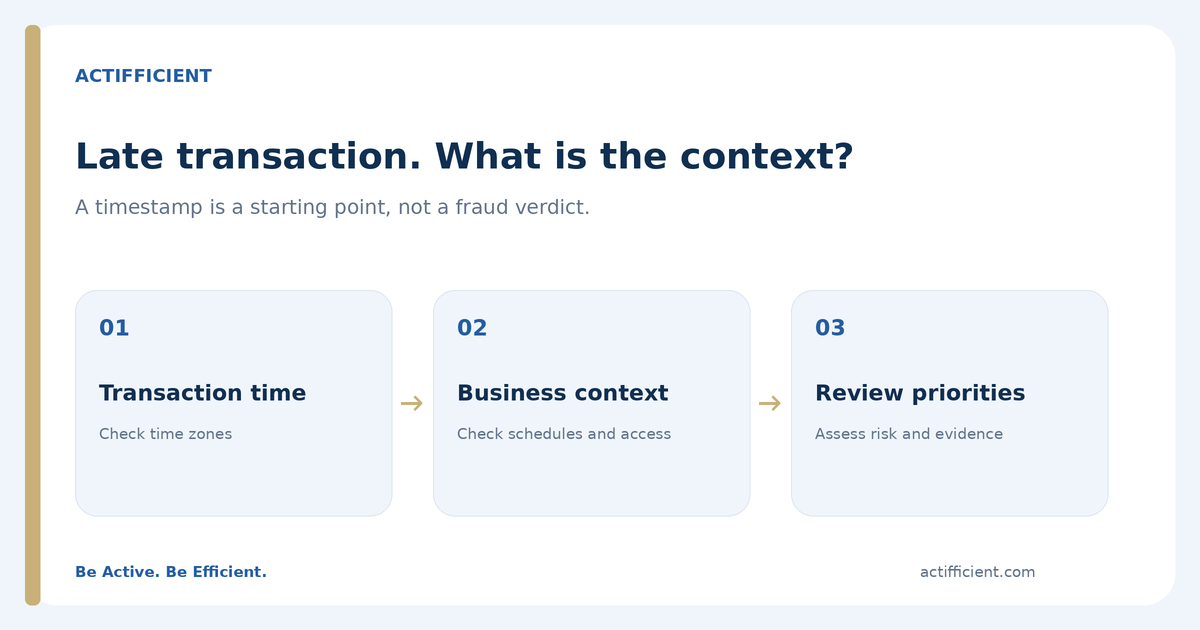
The office closes at six, but a payment receives approval at 11:42 p.m. A supplier's bank details change on a public holiday. A sales reversal is recorded long after the last shift has ended. Those timestamps may catch an auditor's attention, but are they proof that something is wrong? Not necessarily. Some businesses run night shifts, employees work across time zones, and scheduled processes can create legitimate records outside ordinary office hours.
Even so, after hours transactions deserve a closer look when they do not fit the way a business usually operates. The useful question is not whether a late timestamp is suspicious by itself. It is whether the activity has a reasonable business explanation. A focused transaction data analysis can help a team answer that question without combing through thousands of records manually.
Start by understanding what normal looks like
A retail branch may process sales well into the evening, while payment approvals at the head office are normally completed during business hours. A warehouse might receive goods overnight, but changes to supplier banking details are a separate type of activity. Different processes have different normal patterns.
This is why audit data analytics starts with context. Reviewers look at the time, the user, the type of action, the value involved, and the approvals surrounding it. Transaction anomaly detection should highlight departures from expected patterns, not automatically label everyone who worked late as a fraud suspect.
Consider a business that normally approves supplier payments between 8 a.m. and 6 p.m. Several approvals appear after 9 p.m. The first step is to ask whether an authorized person was working late, whether a batch process uses a different time zone, and whether the approval trail supports the activity. A flag is a starting point for inquiry, not a final finding.
Which fields make the review useful?
Good transaction exception testing depends on usable records. The team typically needs a transaction identifier, date and time, action type, user or account, transaction status, and amount where relevant. Approval histories and change logs help establish what happened before and after a particular action.
Time zone handling matters more than many teams expect. One application may store timestamps in UTC while another shows local time. A transaction made during a normal shift can appear to have happened at midnight when those fields are compared incorrectly. Before starting unusual transaction monitoring, confirm how dates and times were captured and whether records from different systems are comparable.
Then agree on the appropriate schedule for each operation. A service desk that runs around the clock should not be tested against a head office's working hours. Internal audit analytics becomes much more useful when the rules mirror actual business activity.
A practical way to identify exceptions
Choose one activity, such as payment approval, sales cancellation, or a change to supplier master data. Define the usual operating window and filter records outside it. Then check the output against staff rosters, authorization levels, emergency procedures, and other available evidence.
When the result contains hundreds of records, do not treat every item as equally urgent. Prioritize unusual access, sensitive master data changes, significant amounts, or activity that occurs repeatedly under the same account. A risk based transaction review brings the team closer to the exceptions that may matter most.
Imagine two entries recorded after 10 p.m. One was made by an employee who was scheduled for an overnight shift. The other changed a vendor payment account and came from a user who normally only views reports. Both are after hours transactions, but they call for very different questions. The second may justify examining access rights and supporting approvals before reaching any conclusion.
Where AI data analytics can help
Spreadsheets may be enough for a small extract. As data grows, teams often spend more time cleaning timestamps and rebuilding filters than reviewing the exceptions. This is one area where AI data analytics can support an audit team's work.
Some analytics solutions help users express an analysis request in ordinary language rather than manually writing every query. A reviewer might ask to group approvals made outside operating hours by user, then inspect the output. AI powered data analysis can make initial exploration more accessible to colleagues who understand the business process but do not regularly write code. Exact capabilities, supported file formats, and deployment arrangements must be confirmed for the chosen solution.
There is still no substitute for checking the underlying logic. Reviewers should be able to identify the period tested, filters applied, and reason each record was selected. An AI assisted result may reveal useful patterns, but it cannot independently know every authorized exception, commercial agreement, or local operating rule.
Exception reports are not fraud verdicts
A thoughtful transaction anomaly detection process includes follow up. Once records are identified, the team should check documented approvals, the user's responsibilities, the business reason for the activity, and whether the action was later reversed or corrected. Each review should leave a clear record of how the conclusion was reached.
Sometimes the most useful finding is a process improvement rather than misconduct. Perhaps the system's standard hours were never updated after a new shift was introduced. Perhaps permissions from a previous role remain active. Unusual transaction monitoring can reveal both data issues and weaknesses in the way a process is administered.
This makes internal audit analytics more valuable as a decision support practice. The team is not simply producing a list of exceptions. It is learning which controls need clarification, which events were expected, and which cases genuinely warrant further investigation.
Begin with one reviewable question
There is no need to scan every system at once. Pick a process that matters, define the time window, agree on the evidence required, and test a manageable period. Decide whether the activity should be reviewed during a scheduled audit or through recurring checks.
The point of transaction data analysis is to improve visibility without losing judgment. When transaction exception testing is paired with a risk based transaction review, finance and audit teams can spend less effort sorting irrelevant records and more time understanding the activity that deserves attention.
Actifficient helps businesses evaluate audit data analytics and practical AI assisted analysis options for their existing data. Explore Actifficient's technology solutions or request a consultation to discuss a review scenario suited to your business.