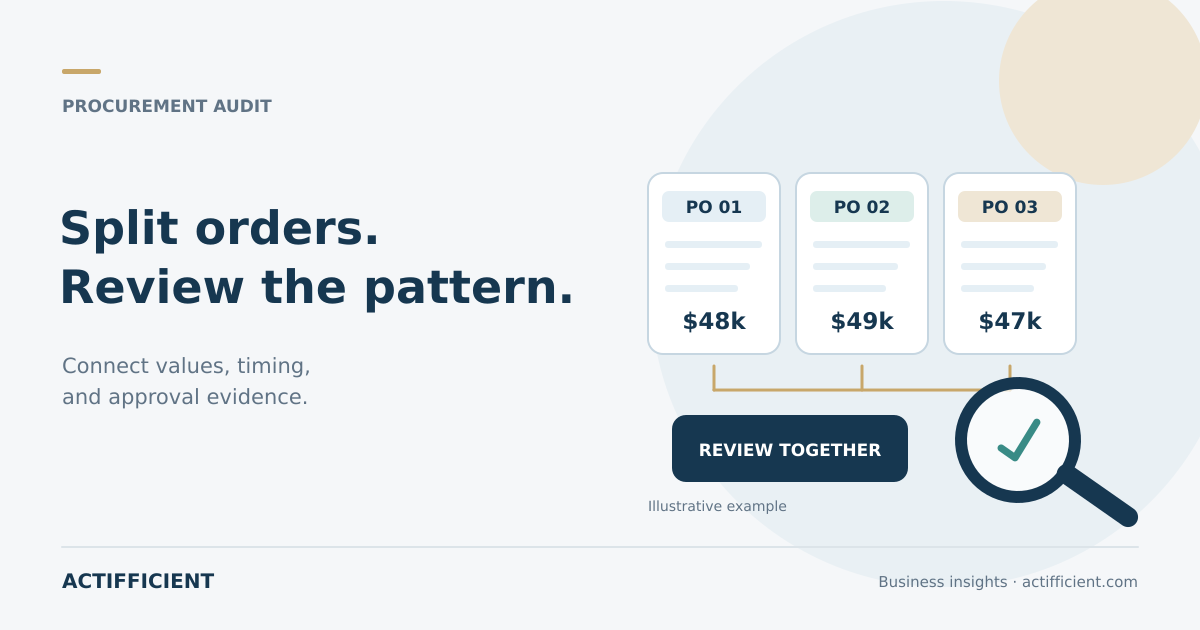
A company requires additional approval for purchases above $50,000. During a review, the audit team finds three orders to the same supplier within two days. Each order is close to the limit, while the combined value is much higher. The pattern deserves attention, but it does not prove that anyone deliberately avoided approval.
Business needs can emerge in stages. The items may support different projects, or an additional requirement may have become known after the first order. This is why possible purchase order splitting should be treated as an indicator for review, not an automatic conclusion.
With purchase data analysis, a team can screen a large population and identify related orders for closer examination. The next step is to review the documents, timing, business purpose, and people involved in the approval process.
Begin with the applicable approval policy
An analysis cannot be reliable if the approval limit is unclear. Collect the authority matrix, sourcing rules, direct purchase requirements, transaction limits, and policy changes that applied during the review period.
What appears to be transactions below approval threshold in January may not have the same meaning after a policy change in July. Match every rule to its effective date, entity, purchase category, and currency.
Also determine whether the limit applies to each order, the total known requirement, one supplier, one project, or purchases within a defined period. A misunderstanding can create a long list of irrelevant alerts.
Group transactions that may share one business context
An initial test can group orders by supplier, requester, approver, department, item category, project, value, and time interval. The goal is to identify orders that may need to be reviewed together.
For example, search for split purchase orders issued to the same supplier within seven days, where the combined amount exceeds the approval limit while each order remains just below it. The test can also consider similar items purchased through different suppliers or requesters within a short period.
Avoid applying one rule to every activity. Daily raw material purchases will look different from consulting services, office equipment, or project based procurement.
Review values that cluster near a limit
A concentration of orders just below a threshold can be useful for procurement anomaly detection. It is still only a pattern. Compare the distribution by supplier, requester, branch, category, and month.
Look for changes after a new approval policy becomes effective. Review whether the same person repeatedly creates or approves the orders, and whether several purchases occur within an unusually short interval.
A simple value distribution chart can reveal where transactions cluster. The team can then open the underlying orders and review their descriptions and business purpose.
Connect orders to supporting evidence
Order data tells only part of the story. A procurement audit should consider requisitions, supplier quotations, contracts, invoices, receiving records, change requests, and approval evidence.
Ask when the total requirement became known. If the full need was known from the beginning but divided without an operational reason, the risk is different from an additional requirement discovered later.
Also check whether the goods or services belong to one project, use similar specifications, arrive at the same time, or appear in related invoices. Evidence helps the reviewer determine whether the purchases genuinely stand alone.
Use AI to extend the review question
AI assisted data analysis can help translate a business question into a test, explore patterns across connected sources, and suggest groups of transactions for review. A knowledgeable user must still assess the logic, data completeness, and business explanation.
A reviewer might request orders from the same supplier within ten days, involving similar categories and a combined value above the approval limit. Results can then be narrowed by project, requester, or approver.
This form of procurement data analytics supports the investigation. It cannot understand every policy exception, urgent operational need, or valid reason from transaction values alone.
Separate explained cases from unresolved exceptions
Create a review table with the transaction group, combined value, time interval, supplier, requester, approval limit, evidence reviewed, process owner explanation, and reviewer conclusion.
Classify results as reasonably explained, awaiting evidence, or requiring further investigation. This approach supports procurement risk monitoring without describing every unusual group as misconduct.
Data quality also matters. Changed supplier identifiers, inconsistent item descriptions, and incorrect dates can hide relationships or create false matches.
Turn the result into better controls
When a pattern repeats, the response may need to address more than one transaction. The company can clarify what constitutes a single requirement, add a combined value check, improve exception documentation, or review delegated authority.
A recurring purchase transaction review can use rules that have already been tested. Thresholds, time windows, and purchase categories should be adjusted when business processes change.
Analytics can accelerate discovery, but conclusions still require evidence and authorized human judgment. Start with one representative scenario, test the logic, and confirm whether the result can be explained and acted upon.
Want to demonstrate a split purchase test using representative company data? Explore Actifficient AI Data Analytics, then contact Actifficient to discuss data structure, approval rules, access, and validation.