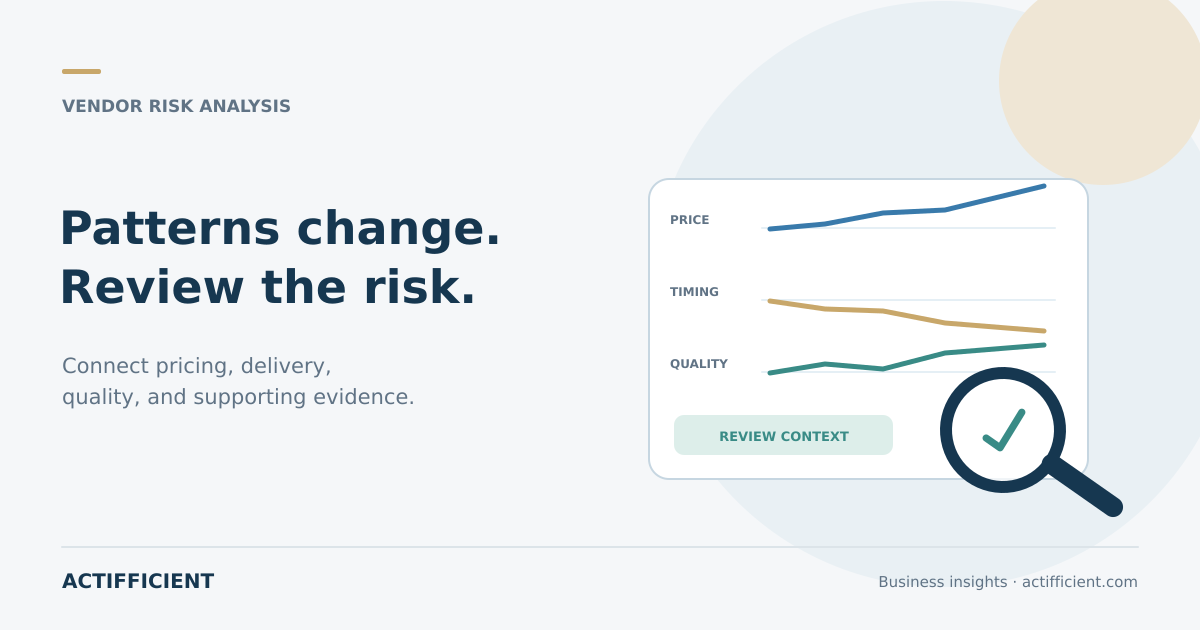
Supplier relationships rarely deteriorate overnight. The warning signs often appear gradually. Prices may drift beyond the usual range, deliveries may arrive late more often, quality may decline, or the business may become increasingly dependent on one supplier. Each change can look reasonable on its own. Vendor risk analysis helps the team view those changes as a connected pattern.
This does not mean labeling a supplier as problematic based on an unusual number. The goal is to identify signals that deserve timely review. AI Data Analytics can help teams explore purchasing, goods receipt, invoice, return, and service records. People still need to interpret the results with business context and supporting evidence.
Why a monthly summary may not be enough
Routine reports usually show total spend, transaction value, or the largest suppliers. Those views are useful, but they may not answer more focused questions. Is a price increase caused by the market, or is it limited to one supplier? Are delays concentrated around critical materials? Has purchasing activity shifted to a newly created supplier entity or bank account?
This is where procurement data analysis becomes valuable. Teams can compare supplier behavior across periods, product categories, and business units. The same approach strengthens a third party audit by helping reviewers choose testing areas based on changing patterns, not only on the largest monetary values.
Connect the data that explains supplier behavior
A useful analysis begins with a clear question and the data needed to answer it. Typical sources include purchase orders, goods receipts, invoices, payments, returns, vendor master changes, quality complaints, and contract records. Where access is appropriate, operational incident logs and service evaluations can add context.
Connections between records matter as much as data volume. Vendor numbers, purchase order references, invoice numbers, item codes, dates, and requesting units need consistent formats. Without reliable links, supplier transaction analysis may surface numerous exceptions that are simply data formatting differences.
Patterns worth reviewing
Possible vendor risk indicators include price increases that differ from comparable categories, a rising rate of late delivery, a bank account change close to a large payment, increasing returns, or purchasing concentration that has no clear operational explanation.
Teams can also use vendor anomaly detection to find unusual combinations. Examples include a new supplier receiving a large order immediately, repeated orders with nearly identical descriptions, or a mismatch between contract and invoice prices. These results are not proof of misconduct. They are prompts to examine approvals, contracts, communications, and market conditions.
Separate risk, performance, and suspected misconduct
A common mistake is to treat every change as the same type of problem. A late delivery may result from a logistics disruption. A price increase may reflect raw material costs. A new bank account may be part of a legitimate company restructuring.
For that reason, vendor performance monitoring should use agreed measures. Teams can review delivery reliability, quality, pricing compliance, complaint resolution, and business dependency. These measures then contribute to a broader vendor risk assessment, alongside financial condition, compliance, information security, and service continuity.
A practical starting process
Start with one risk that process owners can understand. For example, ask whether delivery delays for critical materials have increased during the last six months. Define what late means, choose the comparison period, identify the required data, and assign responsibility for validating the result.
Next, test data quality and choose fair comparison groups. A raw material supplier may not be comparable to a professional services provider. When a pattern appears, review transaction samples, inspect supporting documents, and discuss the case with procurement and operational users. This keeps data driven decision making grounded in operational reality.
Once the initial process is stable, expand the scope to supplier concentration, pricing changes, quality trends, or vendor master changes. Alert criteria should also be reviewed periodically so they do not create excessive noise or overlook important shifts.
AI narrows attention, while people make the decision
AI can help formulate questions, compare many variables, and retrieve context from connected sources that the organization has authorized. It can suggest additional tests or help prioritize findings. However, business explanations, transaction evidence, and follow up decisions remain the responsibility of authorized people.
Explore Actifficient's AI assisted data analysis solution to see how data exploration and anomaly review can be adapted to your team. If you want to test a representative vendor scenario, contact Actifficient for a consultation. A focused first session can show the expected value, limitations, and data requirements before the scope becomes larger.