A customer service team may close dozens of conversations every day, yet the same complaints return the following week. Customers ask again about order status, unclear charges, return procedures, or service commitments that were not completed. When success is measured only by closed tickets, these patterns are easy to miss.
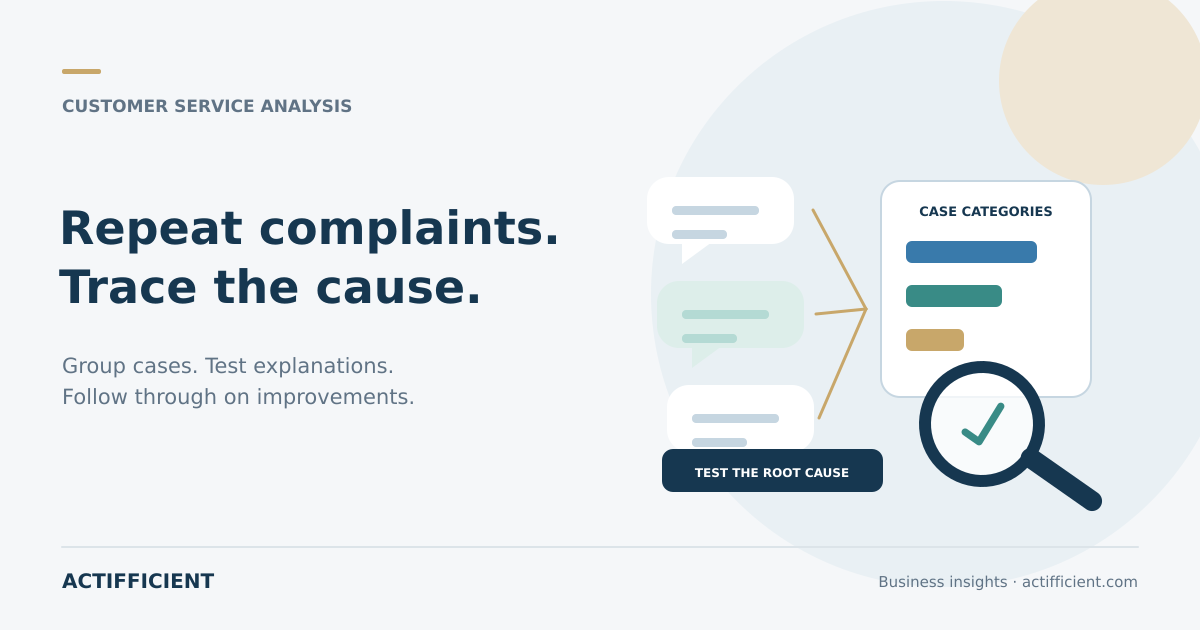
Customer complaint analysis treats conversations as operational evidence. The purpose is not to judge an agent based on a few difficult chats. It is to understand which process, product, information, or policy repeatedly causes customers to contact the company again.
Separate a fast answer from a resolved problem
A fast reply matters, but a conversation is not necessarily resolved because an agent responded. The customer may return through another channel, create a new ticket, or repeat the question to a different agent. This pattern can be explored through repeat contact rate, the proportion of customers who contact the business again about the same need during a defined period.
The number requires context. A customer providing new information does not automatically indicate poor service. Teams should review samples and distinguish necessary follow up from repeated contact caused by an incomplete solution.
Standardize categories before building reports
Conversation labels are often inconsistent. One agent records “late delivery,” another chooses “order status,” while someone else uses “logistics complaint.” They may refer to the same issue, but a report will separate them.
Begin customer conversation tagging with a simple category list. Include the main issue, an initial cause, product type, resolution status, and follow up need. Avoid creating too many labels at first. Each label should have a clear definition and examples so agents use it consistently.
Connect conversations across channels
A customer may begin on WhatsApp, continue on social media, and then send an email when the issue remains unresolved. An omnichannel customer service approach can help teams view context from connected channels, depending on available integrations and the selected package.
The WhatsApp Business API can also support team routing, history, chatbots, templates, and workflows through an appropriate platform. Capabilities vary by implementation. Teams need to test channels, message rules, integrations, and escalation paths before depending on them in daily operations.
Use CRM to preserve business context
Conversations show what customers say, while a customer service CRM can connect that information with profiles, products, transaction status, account ownership, or earlier activity. This makes the analysis more useful. Delivery complaints can be compared by region, courier, product category, or campaign period.
Personal data should remain limited by responsibility. Not every user needs access to every customer detail. Define the minimum information required for service and analysis, then apply suitable access and retention rules.
Build a dashboard that prompts action
A customer service dashboard does not need dozens of charts. Start with questions that the team should answer each week. Which complaints appear most often? Which category is growing fastest? How many cases are reopened? Which issues require help from another team?
Show case counts alongside their share of total conversations. Add trends and recurrence so business growth is not mistaken for declining quality. Authorized process owners should also be able to review representative cases behind the numbers.
Conduct root cause analysis across functions
Customer service root cause analysis should go beyond saying that a customer did not understand. Ask why the information was unclear, where the expectation was created, and what evidence supports the explanation. The source may be a product description, warehouse process, payment integration, return policy, or communication after purchase.
Involve relevant process owners. Agents can explain the language customers use, while operations can examine the underlying process. Select cases that represent the pattern, form a hypothesis, and verify it with transaction data and operational evidence.
Turn findings into measurable action
Customer complaint management becomes useful when every finding has an owner and a follow up. Improvements may include clearer product information, revised notifications, a simpler procedure, agent training, or an operational correction. Define the measure before making the change, then compare results after a reasonable period.
Avoid changing too many things at once. If the company improves a delivery notification, monitor whether order status contacts decline. This makes customer experience improvement something the business can evaluate from real patterns, rather than from impressions alone.
Explore Actifficient's customer communication solution to discuss connected inboxes, CRM, automation, and service reporting. If your team wants to build a more measurable complaint classification and follow up process, contact Actifficient for a consultation. Bring anonymized conversation examples, current channels, and the present resolution process to make the discussion more relevant.