A customer may receive a clear answer from one agent and a different explanation when they return the next day. The problem is not always a lack of effort. The working guide may be vague, the knowledge material may be outdated, or the team may never have agreed on what a good conversation looks like.
Customer service quality assurance helps a team assess how conversations are handled, not merely how quickly they are closed. It can examine accuracy, understanding, empathy, clarity, data protection, and the next action promised to the customer. A review should create useful evidence for service improvement, not become a search for someone to blame.
Define what good service means
Begin with observable behavior. Terms such as friendly and professional are too broad on their own. A useful standard may require an agent to confirm the customer's need, avoid requesting unnecessary personal data, explain the next step, and check whether the outcome is understood.
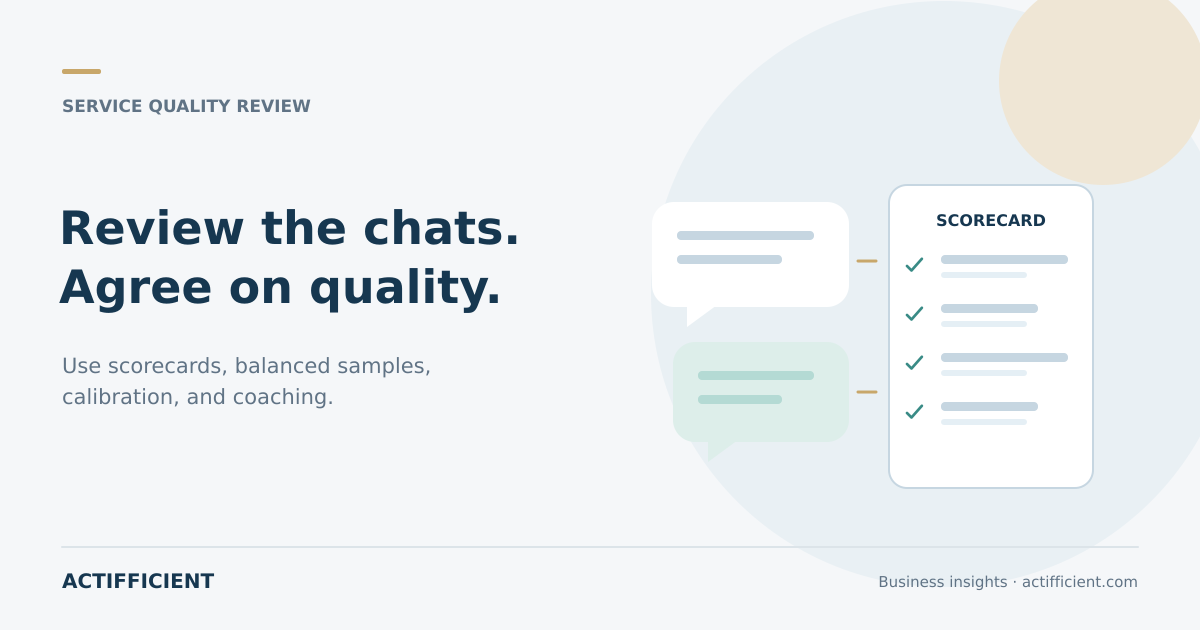
Build a concise service quality checklist for the type of work being reviewed. Sales, technical support, and complaint handling may need different criteria. A short scorecard that reviewers understand is more useful than a long form applied inconsistently.
Select a representative sample
A customer service conversation audit becomes misleading when it includes only the angriest complaints. Sample different channels, issue types, agents, working hours, and levels of complexity. Include conversations that ended well so the team can identify practices worth repeating.
Combine random selection with risk based selection. Escalations, low ratings, repeated contacts, and interactions involving sensitive information may deserve attention. However, a risk based sample should not be presented as a complete picture of an agent's work.
Review the substance, not personal style
During a customer chat review, ask whether the agent understood the request, used reliable information, and offered an action the customer could follow. Writing styles can vary while still meeting the same standard.
Avoid notes such as “this does not sound right” without evidence. A reviewer should identify the relevant message, explain the effect, and offer a better example. Specific feedback is easier to apply than a score with no explanation.
Use context from connected channels
An omnichannel CRM may help authorized reviewers see conversation context, follow up activity, and case ownership across supported channels. Availability depends on the selected package, integration, and permissions. Customer information should still be used only for an appropriate purpose.
For conversations handled through the WhatsApp Business API, teams may also review the use of approved message templates, communication consent, automation handoff, and outcome records according to the active configuration. Rules and features should not be assumed to be identical across every channel.
Calibrate before relying on scores
Two people can score the same conversation differently. Customer service reviewer calibration asks reviewers to assess the same examples, compare their reasons, and agree on how each criterion should be interpreted.
Repeat calibration when the scorecard changes or a new type of interaction appears. The goal is not to remove all judgment. It is to reduce scores driven by personal preference rather than the agreed service standard.
Keep coaching separate from punishment
A customer service agent evaluation should look for patterns instead of defining a person through one interaction. When several agents repeat the same inaccurate explanation, the knowledge source or procedure may be the real issue. When a gap is specific to one person, support can focus on that skill.
Effective customer service coaching selects one or two behaviors, agrees on an improved response, and reviews later conversations for progress. Agents should also have a chance to explain operational context that is missing from the transcript.
Monitor whether the change works
Conversation quality monitoring becomes valuable when it continues over time. Compare criteria, issue types, channels, and periods. Do not focus only on an overall score because an increase can hide a decline in accuracy or data protection.
Connect findings to knowledge updates, training, routing rules, and workflow design. If customers continue to return with the same issue, examine whether the original response solved the underlying need.
Start with one practical scorecard, a balanced sample, and a short calibration session. Explore Actifficient's customer communication solution to understand inbox, CRM, workflow, and reporting options that may support service operations. To map review needs while limiting unnecessary access to customer information, contact Actifficient for a consultation.