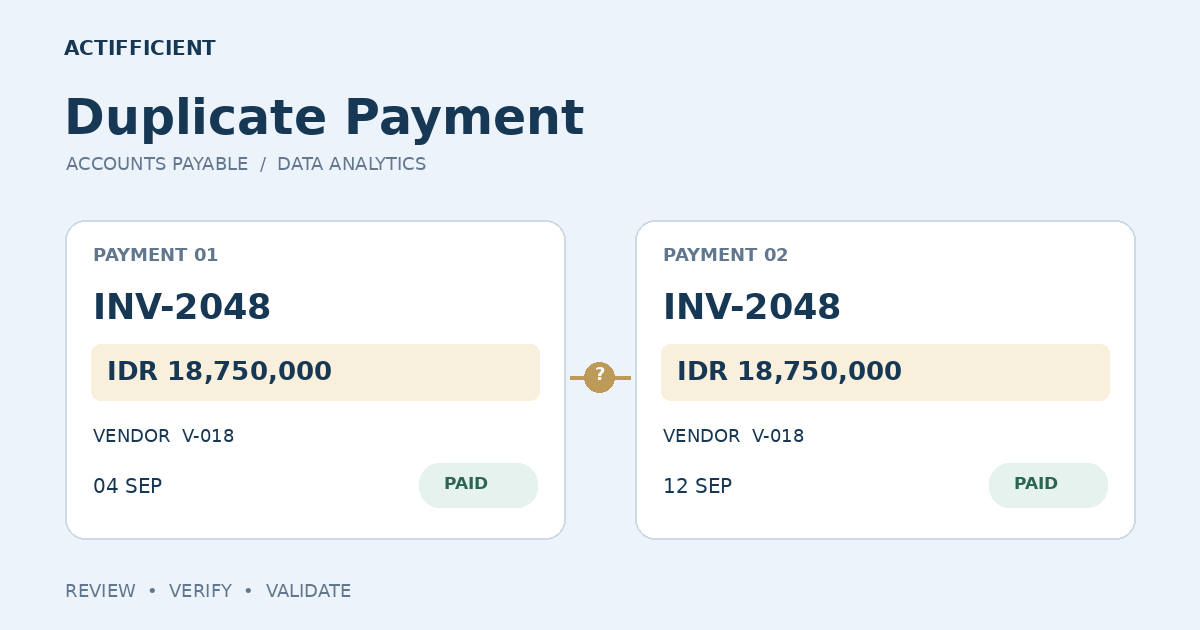
A supplier sends an invoice, the Finance team reviews it, and the payment is approved. Everything appears to be in order. A week later, another payment is processed against what turns out to be the same invoice. Both transactions appear in the company's financial records, but the duplication may not become apparent until someone takes a closer look.
This is a typical example of a duplicate payment, an issue that can occur even in organizations with established accounting systems and payment approval procedures.
For Accounts Payable (AP) and Internal Audit teams, the challenge is not simply identifying two transactions with the same amount. It is understanding whether those transactions represent separate business obligations or whether the company has paid for the same invoice twice.
Fortunately, duplicate payment detection can begin with transaction data that the organization already has. With the right analytical approach, Finance and Audit teams can identify potential duplicates and focus their attention on payments that warrant further investigation.
What Is a Duplicate Payment in Accounts Payable?
A duplicate payment occurs when an organization pays more than once for the same underlying obligation. It may result from repeated invoice processing, inconsistent transaction records, or errors in the payment workflow.
One important distinction is that a duplicate invoice is not necessarily a duplicate payment.
A supplier invoice might appear twice in an accounting system, but only one of those entries may have been paid. The other record could have been cancelled, rejected, or created as part of a correction. In such cases, duplicate invoice detection may identify repeated records without establishing that any money was paid twice.
A confirmed duplicate payment requires additional evidence showing that multiple payments were made against the same obligation without a legitimate business reason.
Beyond the financial impact, investigating duplicate vendor payments can create extra administrative work. Finance teams may need to review payment records, reconcile bank transactions, contact suppliers, and correct accounting entries.
The issue is significant enough to be included in Accounts Payable performance benchmarking. According to APQC's benchmarking measure, the median proportion of duplicate or erroneous disbursements was 1.5% by transaction count across a sample of 1,686 companies. This figure refers to the number of payments, not the percentage of money lost.
Why Do Duplicate Vendor Payments Happen?
Duplicate payments are not always the result of someone processing the same document carelessly. In many cases, the circumstances are more complicated.
A vendor may resend an invoice because payment confirmation has not arrived. The same document might reach different employees through separate communication channels, leading to more than one entry in the Accounts Payable records.
Data entry differences can also make potential duplicates difficult to recognize.
Consider an invoice originally recorded as INV-2048. If another entry appears as INV2048, an exact comparison of invoice numbers may treat the references as different even though they look almost identical to a reviewer.
These variations are particularly relevant when a duplicate payment audit relies on predefined matching conditions. A rule designed to detect identical invoice numbers will not necessarily identify records with different formatting.
At the same time, not every repeated amount or similar invoice represents an error. A supplier might legitimately issue separate invoices for the same amount, or a company may have agreed to pay an obligation in installments.
This is why effective duplicate payment detection requires more context than simply highlighting matching values.
What Data Do You Need for Duplicate Payment Detection?
Before running a duplicate payment analysis, the first step is to understand what information is available.
Useful fields generally include the vendor identifier, invoice number, invoice date, payment amount, currency, payment date, transaction status, and payment reference. Purchase order information and reversal records may also help when additional verification is required.
The quality and completeness of these fields directly affect the analysis. A dataset containing only invoice details may be sufficient for detecting repeated invoices, but it does not necessarily establish whether two payments were actually made.
For a duplicate payment audit, Accounts Payable records should therefore be compared with actual payment information whenever possible.
Teams can start with a relevant export from their accounting or financial system. The goal is not to collect every available field, but to have enough information to compare transactions meaningfully and verify what happened.
How to Detect Duplicate Payments in Transaction Data
A practical approach begins with simple matching conditions and then considers additional scenarios where necessary.
Compare vendor IDs, invoice numbers, and payment amounts
One of the first checks in vendor payment analysis is to identify records that share the same vendor identifier, invoice number, and amount.
Consider the following example.
| Vendor ID | Invoice Number | Amount | Payment Date | Status |
|---|---|---|---|---|
| V-018 | INV-2048 | $1,250 | Sep 4 | Paid |
| V-018 | INV-2048 | $1,250 | Sep 12 | Paid |
| V-018 | INV-2049 | $1,250 | Sep 30 | Paid |
The first two records should be reviewed because they share the same vendor, invoice number, and payment amount but have different payment dates.
The third record has the same value, but a different invoice number. That alone is not sufficient to classify it as a duplicate.
These examples are illustrative. Before reaching a conclusion, the Finance team should verify the corresponding bank payment references and supporting invoice records.
Check invoice number variations
Exact matching is a useful starting point, but it may not identify every potential duplicate.
Invoice numbers sometimes contain additional spaces, punctuation, prefixes, or leading zeros. Those differences can occur during manual entry or when data moves between systems.
Depending on the available data and analytical method, additional tests may compare invoice references after standardizing their format. Amounts, vendor identifiers, and payment dates can provide further context.
These checks require appropriate comparison rules and validation. A software tool should not be assumed to identify every variation automatically simply because it supports duplicate transaction analysis.
Verify the underlying payment
A flagged transaction is an invitation to investigate, not a final finding.
The review should determine whether both payments were completed, whether one transaction was reversed, and whether the amounts relate to the same business obligation.
Without this step, a duplicate payment audit may incorrectly classify legitimate payments as errors. Conversely, a real duplicate could remain undetected if the analysis overlooks important transaction details.
How Can AI Data Analytics Help Detect Duplicate Payments?
Duplicate payments can be examined using spreadsheets, database queries, or traditional audit analytics tools. These methods remain useful, particularly when the organization already has well-established analytical procedures.
However, preparing the analysis can become time-consuming when users need to develop new queries or examine different combinations of transaction fields.
AI data analytics software can help make this process more accessible.
Certain AI-powered audit analytics solutions allow users to describe their analytical requirements in plain English. The software then helps construct a query based on the available dataset structure, without requiring the user to write SQL manually.
For duplicate payment detection, this means an analyst can begin with a request to identify repeated combinations of vendor IDs, invoice numbers, and payment amounts.
Some solutions also provide ready-to-use duplicate payment analysis templates. These give users a practical starting point when examining Accounts Payable data, particularly if they do not regularly work with analytical scripts.
Another useful capability is suggesting relevant analyses based on the actual columns in a dataset. Rather than providing only generic advice, the AI can use information about the available fields to recommend checks that may be appropriate for the data.
This approach can benefit both Finance professionals who need occasional transaction analysis and Internal Audit teams that want to examine vendor payment records without relying on technical specialists for every new query.
For audit purposes, being able to document the queries performed and trace the analytical process is also valuable.
It is important to distinguish this capability from payment processing automation. An AI audit analytics tool that identifies potential duplicate payments does not necessarily approve, reject, block, or reverse payments in the company's accounting system.
Its role is to support duplicate payment analysis and investigation, helping users identify transactions that deserve further attention.
How Often Should Vendor Payments Be Reviewed?
The appropriate review frequency depends on the organization's transaction volume, payment process, and risk exposure.
Some teams may need to examine duplicate payment risks as part of regular reconciliation activities. Others may perform ad hoc reviews during an internal audit or when investigating a specific financial concern.
Regardless of the review schedule, the period covered by the data matters.
For example, an analysis limited to September transactions may not identify a payment made in September against an invoice that was already paid in August. A broader transaction history may be required to detect such cases.
The objective is to ensure that the analysis has enough historical context to support meaningful comparisons.
Frequently Asked Questions About Duplicate Payments
What is the difference between a duplicate invoice and a duplicate payment?
A duplicate invoice refers to repeated invoice records that may represent the same obligation. A duplicate payment occurs when the organization actually pays that obligation more than once without a valid reason.
Can duplicate payments be detected in Excel?
Yes. Excel can be used to compare vendor identifiers, invoice numbers, payment amounts, and other transaction fields. AI audit analytics may be useful when users want more flexible analysis without manually developing every query.
Does a duplicate payment automatically indicate fraud?
No. Duplicate payments may result from administrative errors or process weaknesses. Any suspicion of fraud requires further investigation and sufficient supporting evidence.
Start with the Vendor Payment Data You Already Have
Finding potential duplicate vendor payments does not necessarily require replacing an existing accounting system.
Organizations can begin by reviewing their Accounts Payable and payment records, identifying relevant matching conditions, and examining transactions that appear to involve repeated obligations.
AI data analytics can make this process more accessible by helping users construct analyses, explore transaction patterns, and work with their existing data without extensive programming knowledge.
The objective is not to turn every matching transaction into an audit finding. It is to give Finance and Internal Audit teams a more practical way to identify potential duplicate payments and make informed decisions about what requires further review.
Would you like to explore duplicate payment detection using your organization's transaction data?
Actifficient provides AI Data Analytics solutions that support transaction analysis, dataset-based analytical recommendations, and audit-oriented data exploration.
Explore our business technology solutions, or speak with the Actifficient team to discuss your Accounts Payable analytics requirements and arrange a product demonstration.