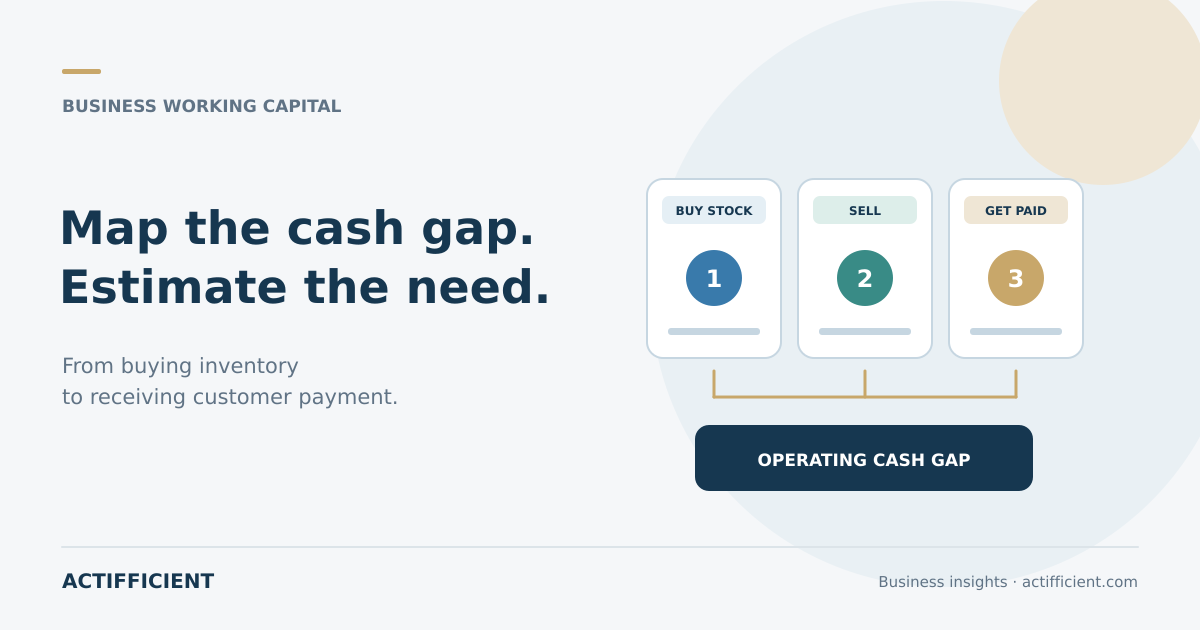
Orders are growing, but the business bank account feels tighter. The company must purchase stock, pay employees, and cover delivery costs before customers settle their invoices. The business appears to be growing, yet cash receipts and payments occur at different times.
This gap often leads a company to consider working capital financing. Before applying, the owner needs to understand how much funding is required, what it will pay for, and where repayment will come from. A rough estimate can leave the company short of cash or create an obligation that does not fit its payment capacity.
Estimating working capital needs involves more than looking at today's bank balance. The calculation should follow the operating cycle, invoice dates, routine obligations, and expected business activity over the coming weeks or months.
Separate working capital from the funding request
In simple terms, business working capital is current assets minus current liabilities. Current assets may include cash, receivables, and inventory expected to become cash or be used within the short term. Current liabilities include supplier balances, payroll, tax, and other obligations due soon.
That number is not automatically the amount a company should borrow. Two businesses can show similar net working capital while experiencing very different cash pressure. One may receive customer payments in advance, while another waits 60 days after delivery.
For that reason, how to calculate working capital for a financing decision requires a schedule of cash movements. The practical questions are when money leaves, when it returns, and how large the gap becomes.
Map cash over the next several weeks
Build a simple cash flow forecast covering eight to twelve weeks. Enter expected customer receipts, then place supplier payments, payroll, rent, tax, debt payments, and other operating needs in the weeks when they are due.
Use more than one scenario. A base case follows the most likely schedule. A cautious case assumes some customer payments arrive late or costs increase. A growth case adds the purchases and operating costs required to fulfil additional orders.
Pay attention to operating cash flow, not just accounting profit. A credit sale can increase revenue without adding cash immediately. An inventory purchase may use cash well before the related product is sold.
Understand the cash conversion cycle
The cash conversion cycle estimates how long cash remains tied up in operations. It generally combines inventory days and receivable days, then subtracts the time the business has to pay suppliers.
Suppose inventory remains in stock for 40 days, customer payments arrive 30 days after a sale, and suppliers allow 20 days for payment. Cash may be committed for roughly 50 days. This is only an illustration. A real calculation should use the company's average data and consider its industry.
A longer cycle can result from slow moving stock, delayed customer collections, or supplier payments made earlier than necessary. Financing may bridge the timing gap, but process improvements are still important if the business wants to avoid an expanding funding requirement.
Match financing to the source of the need
When the gap comes from valid customer invoices that have not yet been paid, invoice financing may be one option to review. Invoice eligibility, customer quality, available amount, cost, and repayment arrangements depend on the provider's criteria.
When funds are needed to acquire goods for sale, inventory financing may align more closely with the underlying requirement. Eligible inventory, ownership documents, security, and business profile still require evaluation.
A revolving facility may suit recurring needs when its limit and terms fit the operating pattern. Financing based on purchase invoices follows a different structure. Do not select an option only because the application appears convenient. The repayment source should match the reason cash is needed.
Estimate the amount from the lowest cash point
Use a weekly forecast before the proposed additional financing that already includes opening cash, expected receipts, and all scheduled payments. Identify the lowest projected closing cash balance, then define the minimum cash balance or buffer to retain. The estimated additional funding gap is the amount by which that minimum exceeds the lowest projected balance, with a floor of zero. Do not count cash or obligations again if they are already included in the forecast.
The result is an initial estimate, not a promise of an approved amount. Providers may assess business history, transactions, documents, security, and repayment capacity differently.
Avoid increasing the request simply because a higher limit sounds useful. Costs and payment obligations continue under the agreement. A request that is too small can also create another funding problem before the first operating cycle is complete.
Review the offer before committing
A business financing application should explain the purpose, amount, expected period of use, repayment source, transaction history, and requested documents. Complete information supports the review but does not guarantee approval.
Compare total cost, duration, payment schedule, security, penalties, drawdown conditions, and early repayment terms. Test the obligation against the cautious scenario. If customer payments arrive two weeks late, can the business still make the required payment?
Appropriate financing is not simply the facility with the largest limit. It fits the source of the need, the operating period, and the company's repayment ability.
Want to map the funding gap and understand available options? Explore Actifficient working capital financing solutions, then contact Actifficient to discuss the intended use and initial documents. Eligibility, limits, costs, and disbursement remain subject to the provider's assessment and approval.