An employee believes the receipt was submitted in a chat. The manager thinks finance has the request. Finance is waiting for missing cost information. When payment is late, every party believes the work was already completed.
A slow reimbursement process often begins before finance prepares payment. Policies are unclear, evidence is scattered, categories are inconsistent, and nobody can see the current status.
Expense management software can connect submission, review, approval, and payment. The business still needs clear rules and ownership.
Write a policy employees can understand
A reimbursement policy should explain eligible expenses, limits, required evidence, submission deadlines, currency treatment, tax considerations, and exceptions.
Avoid vague phrases such as “reasonable expenses will be reimbursed.” Provide examples for travel, local transport, meeting meals, accommodation, and urgent purchases.
Communicate the policy before the employee spends money. A rule explained only after submission will create unnecessary disputes.
Use one submission route
When receipts arrive through chat, email, and paper, the team cannot easily determine whether a claim is complete. Use one form or employee reimbursement app as the primary source.
Collect information that is actually required, such as date, category, business purpose, project, cost center, payment method, value, and evidence. Do not ask employees to enter the same data in several places.
A claim number helps everyone refer to the same transaction without searching through messages.
Attach evidence to each claim
Digital receipts should connect to the correct claim line. The image needs to show the date, merchant, items, and amount clearly.
Define rules for lost receipts, transactions without formal receipts, and one bill covering several participants. Exceptions should include a reason and appropriate approval.
Automated checks can identify missing fields or rule exceptions. A person still needs to review cases where the context is incomplete.
Route approval according to risk
Employee expense approval does not need the same route for every category and value. A small routine claim may use a simple route. A larger amount, specific category, or project may require a manager, budget owner, and finance.
Avoid approval layers without a clear purpose. Each approver should know what to review. A manager can assess business purpose and budget, while finance checks evidence, classification, tax, and completeness.
Within the expense claim workflow, define review expectations and a substitute approver for absences.
Return incomplete claims with a clear reason
When a submission needs correction, explain exactly which line and information require attention.
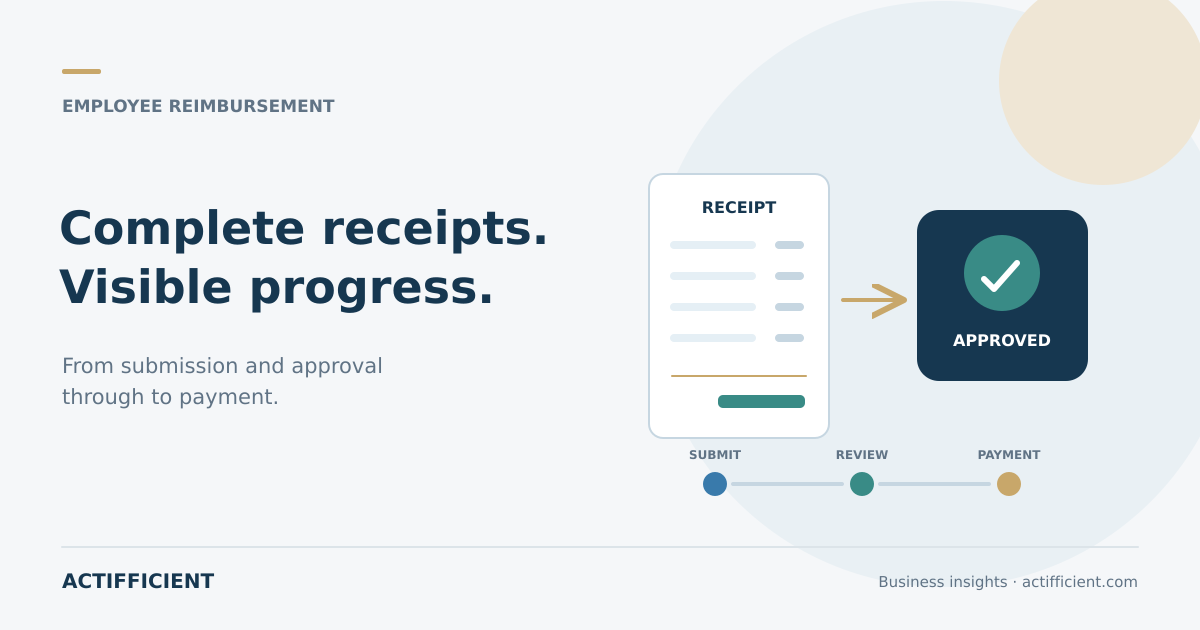
Statuses such as draft, submitted, pending approval, correction required, approved, and paid help employees understand progress.
Keep the change history. When an amount or category changes, later approvers need the updated information.
Separate approval from payment
An approved claim is not necessarily paid immediately. Explain the employee expense reimbursement schedule, payment method, and cut off date.
Finance needs a final list of approved claims. After payment, record the reference and date so the request does not remain at “approved”.
Reconciliation with bank or accounting records helps confirm that payment reached the correct person and account.
Use reporting to improve the process
Employee expense reports can show cost by category, department, project, period, and status. Use the information for budgeting and process improvement, not merely to identify the highest claimant.
Review claims that are frequently returned, long approval times, confusing categories, and repeated exceptions. These patterns can reveal a policy or form that needs improvement.
Operational cost control works better when rules are understandable, evidence is connected, approval reflects risk, and status is visible.
Fast reimbursement does not mean skipping review. A well designed process reduces rework so review can focus on the right issues.
Want to organize reimbursement requests, approval, evidence, and reporting? Explore Actifficient expense management solutions, then contact Actifficient to discuss policies, approver structure, employee volume, and integration needs.