The beginning of the month is often the busiest time for a finance team. Missing invoices need to be chased, bank transactions remain unmatched, branch expenses arrive late, and management is already asking for reports. This does not necessarily mean the team is working too slowly. The process may lack a clear sequence, deadline, and owner.
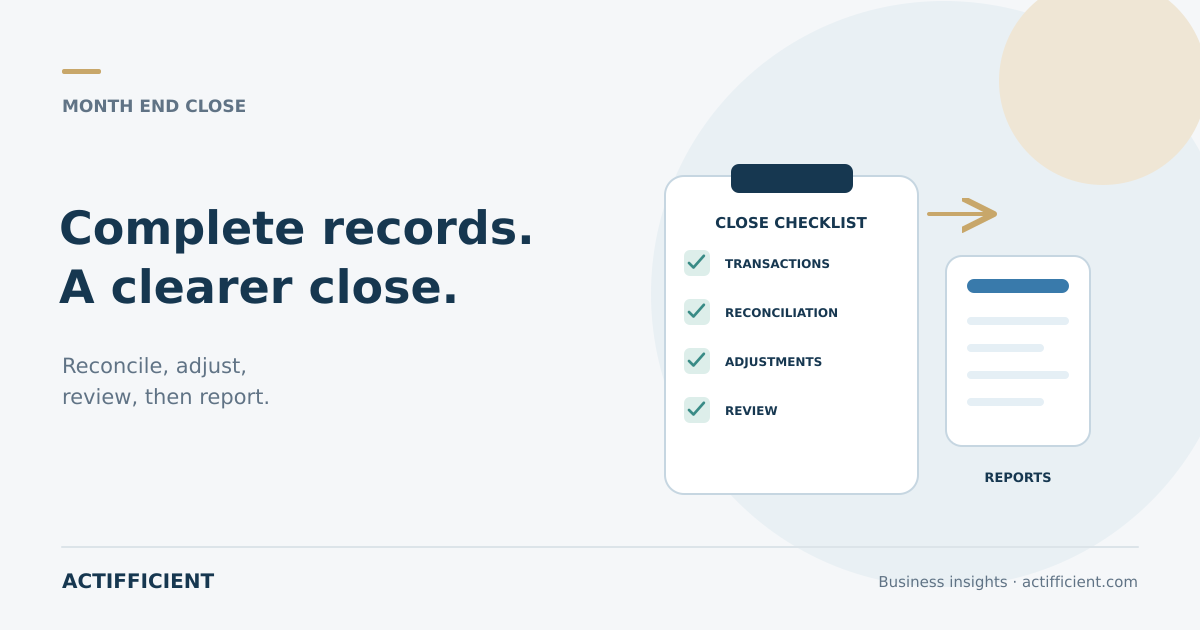
A month end close finalizes the records for one period before reports are used for decisions. It includes confirming that transactions are complete, reconciling accounts, posting adjustments, reviewing balances, and producing reviewed reports.
Set the calendar before the month ends
Do not wait until the first day of the next month to discuss closing. Build a calendar for document submission, transaction cut off, reconciliation, journals, review, and report release. Assign an owner to each task and define cover when that person is unavailable.
A month end close checklist works best when divided into preparation, execution, and review. Preparation covers outstanding documents and routine entries. Execution covers reconciliations and adjustments. Review covers reasonableness checks, approval, and report distribution.
Complete transactions before reconciling accounts
Make sure sales, purchases, expenses, receipts, payments, payroll, bank charges, and intercompany activity are recorded in the correct period. Incomplete business transaction recording can make a reconciliation appear incorrect when the real problem is a missing document.
Use a recurring transaction list so rent, subscriptions, depreciation, and other routine obligations are not overlooked. Where documentation remains incomplete, follow the company's accounting policy and seek professional accounting advice when necessary.
Reconcile bank and cash accounts
Bank reconciliation compares the accounting records with bank activity. Review unallocated receipts, unrecorded payments, bank charges, duplicate transactions, outstanding checks, and timing differences. Every difference should have an explanation and next action.
Include petty cash, corporate cards, payment wallets, and other accounts used for operations. Even a small balance can carry an old unresolved transaction into future periods when it is not reviewed.
Match receivables and payables to supporting records
Accounts receivable reconciliation compares customer balances with invoices, payments, credits, returns, and corrections. Review old invoices, unapplied payments, and negative balances that need explanation. An aging report helps the team select accounts for follow up.
Perform a similar review for supplier balances. Match them to invoices, payments, credit notes, and supplier statements where available. Separate timing differences from recording errors so the corrective action is appropriate.
Post adjustments with evidence and approval
Adjusting journal entries may be required for accruals, prepayments, depreciation, allocations, classification corrections, or other transactions under the company's accounting policy. Every journal should have an explanation, calculation, supporting evidence, preparer, and approver.
Avoid using a journal as a shortcut to close an unexplained difference. If the cause is still unknown, record it as an open item and assign responsibility. A correction made without an explanation can create another problem in the next month.
Review balances and unusual changes
After reconciliations and journals are complete, review the trial balance. Compare it with the prior month, budget, and expected business pattern. Look for accounts that should be zero, large movements, unusual negative balances, and high value transactions near period end.
A review is not limited to finding mathematical errors. The team should decide whether the result makes business sense. If sales increased while delivery cost did not change, a transaction may be missing or a classification may need review.
Release reports with a clear status
Monthly financial statements may include profit and loss, financial position, cash flow, and supporting schedules as required. Show the period, preparation date, draft or final status, and reviewer. Avoid distributing several versions without clear identification.
During monthly book closing, define who can reopen a period and under which circumstances. Changes after a final report should be recorded so users understand whether the figures they saw still match the latest version.
Use software for consistency and change history
Online accounting software can support invoicing, recording, reconciliation, reporting, and user access according to its features and configuration. A suitable system can also create an accounting audit trail, such as transaction and change history available to authorized users.
Technology does not automatically correct a wrong account, a missing document, or unclear responsibility. Test the system against the company's actual workflow, including branch transactions, approvals, bank integration, period corrections, and data export.
A consistent close makes issues visible earlier and reduces work at year end. Start with a simple checklist, measure the time spent at each stage, and improve the part that is repeatedly late.
Explore Actifficient's accounting and operational technology portfolio to discuss recording, reconciliation, access, and reporting needs. If your business wants to refine the close process before selecting or configuring a system, contact Actifficient for a consultation. Bring a sample calendar, transaction sources, and current reports to make the first assessment more concrete.