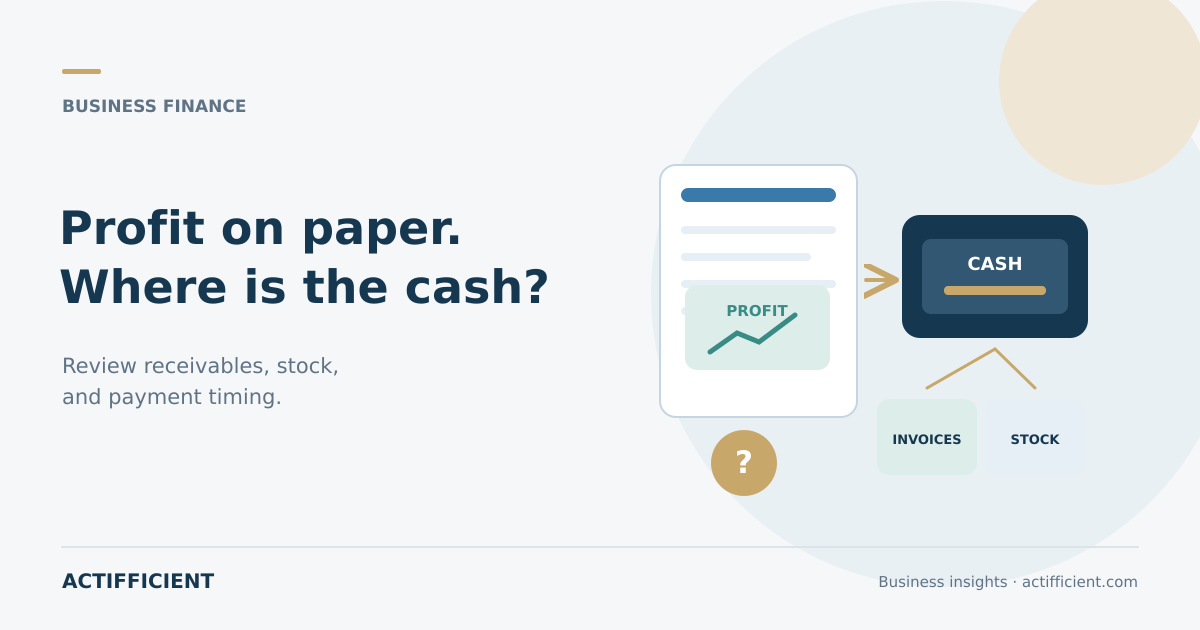
Sales are growing and the accounts show a profit, yet the bank balance keeps falling. When payroll, rent, and supplier bills become due, the owner wonders where the money went.
A profitable business but no cash is not necessarily looking at an incorrect report. Profit and cash answer different questions. Profit compares revenue with expenses for a period, while cash reflects money that has actually moved.
Understanding profit vs cash flow helps business owners recognize pressure before a payment is missed. A company can look healthy on its income report while struggling to settle bills because customers have not paid or too much money is tied up in inventory.
A sale does not always create immediate cash
When a company sells on credit, it can record revenue before receiving payment. Until the customer pays, that amount remains a receivable.
Review unpaid customer invoices by due date, customer, value, and follow through status. Strong sales will not support liquidity if collection time continues to increase.
Reliable accounts receivable tracking shows which invoices are current, overdue, disputed, or paid but not yet matched. This information supports a more realistic view of when cash may arrive.
Inventory can absorb available money
Inventory is an asset, but buying it uses cash. A business that expands stock too quickly can experience pressure even when the goods are expected to sell at a profit.
Review slow moving items, supplier minimums, safety stock, and frequent returns. The total inventory value is not enough. Management should understand how long money remains tied up before stock becomes a sale and then cash.
Connect purchasing, sales, and inventory information when supported. Better visibility helps the company avoid ordering solely because someone is worried about running out.
Supplier payments follow a different schedule
A company may collect from customers in 45 days while paying suppliers in 14 days. That timing gap creates a cash requirement even when the sales margin is positive.
Effective cash flow management maps supplier bills, loan payments, taxes, rent, payroll, and recurring expenses against expected receipts. The comparison should use realistic collection dates, not total sales.
Asset purchases, loan principal, and owner withdrawals can also reduce cash without appearing entirely as a cost in the same profit and loss statement. This is why the income report should not be reviewed alone.
Use a cash flow statement to explain movement
A cash flow statement groups cash movement into operating, investing, and financing activities. It helps explain why the balance changed while the company reported a profit.
Repeatedly negative operating cash flow deserves attention. Slow collection, growing inventory, supplier payments, or rising costs may be responsible. Compare several periods before describing one month as a trend.
Make sure bank accounts, petty cash, digital payments, and material transactions are recorded. An incomplete source produces an incomplete report.
What accounting software can and cannot do
Online accounting software can bring invoicing, payment status, bookkeeping, bank reconciliation, and financial reports together, depending on the selected features and integrations.
With cloud accounting software, owners and finance staff can review information using appropriate access. The system still depends on correct opening balances, account classifications, and complete transactions.
Reconcile bank activity regularly. Review unmatched entries, fees, duplicate payments, and receipts that have not been connected to invoices. Define who records information, who checks it, and who approves changes.
Build a simple cash forecast
Begin with today's cash balance. Add realistic receipts based on receivable aging and customer commitments. Subtract scheduled payments, then view the balance by week.
Do not assume that every invoice will arrive on its due date. Use customer payment patterns and label uncertain assumptions. Update the forecast when new information becomes available.
This habit improves business financial monitoring for decisions such as buying stock, postponing discretionary spending, accelerating collection, or negotiating supplier terms.
Profit remains essential, but a business pays obligations with cash. Reading both measures together provides a more useful picture of operational health.
Want to organize invoices, bookkeeping, receivables, bank reconciliation, and financial reporting? Explore Actifficient online accounting software, then contact Actifficient to discuss transaction flows, users, branches, and integration needs.