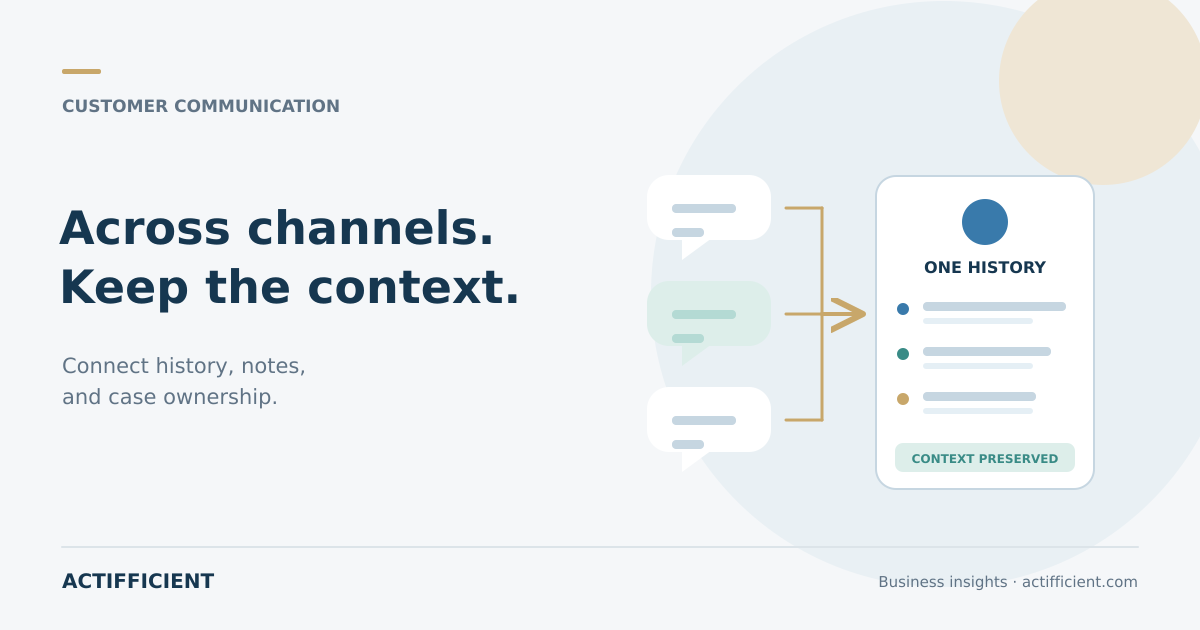
A customer asks a question on Instagram, sends transaction details through WhatsApp, and then calls because the issue is still open. The person answering the call cannot see what happened earlier. The customer must repeat the name, order number, and entire story.
This is not always an agent performance problem. Conversations sit in separate applications, profiles are not connected, and the next action exists only in one employee's memory. As a result, customer conversation history breaks whenever the channel or owner changes.
An omnichannel customer service approach can coordinate interactions from connected channels. A platform alone does not create useful context, however. The business still needs to decide what information is recorded, who can see it, and how work moves between people.
Map the real customer journey
Begin by reviewing the customer journey from the customer's perspective. Where do people ask initial questions? Which channel is used to send a receipt or order number? When does a conversation move from sales to support or finance?
Include more than the channels listed in the official process. Customers may use a website form, social media comment, WhatsApp, email, and telephone at different stages. Identify the transitions that cause the most repetition and delay.
This map helps prioritize channel integration. A company does not need to connect every channel on the first day. Start with the routes carrying the highest volume or the cases with the greatest operational impact.
Decide how customer identities are matched
One person may use a phone number, email address, and social media name that do not obviously match. Without rules, the same customer can have several profiles. Rules that are too loose can combine two different people.
Within an omnichannel CRM, define the primary identifier and the supporting information allowed for profile matching. An order or customer number can help with transaction cases. Avoid collecting more sensitive data than the process requires.
Create a controlled process for merging duplicate profiles and separating incorrect matches. Keep a record of who made the change and why.
Present context instead of a wall of messages
Connecting the WhatsApp Business API with other supported channels should not force an agent to read hundreds of messages before responding. The working view should make the latest status, case owner, issue summary, and next step easier to find.
Separate customer messages, internal notes, and transaction records. Internal notes must not be sent to the customer. Unverified information should be clearly labelled so it is not treated as a confirmed fact.
A well configured customer service inbox lets an agent understand the situation without opening several applications. Channel coverage, history, and integration still depend on the selected modules and setup.
Create a clear handover rule
An effective agent handover answers four questions: what is the issue, what has been done, what is still pending, and who owns the next action. Moving a chat to another queue without this information does not solve the underlying problem.
Use practical case categories and transfer reasons, such as payment verification, order changes, technical support, or sales follow up. Too many categories make it difficult for agents to choose consistently.
When a customer moves to another channel, the agent can confirm the known context briefly instead of asking for the complete story again. This shows that the earlier information was received and understood.
Control access and retention
Centralized customer data does not mean every employee should see every field. Sales, support, finance, and administrators may require different permissions.
Define who can view, edit, export, and delete information. Review retention periods, audit needs, customer permission, and applicable data protection requirements.
Access must also change when an employee moves roles or leaves. Shared credentials make actions difficult to trace and increase the risk of inappropriate data use.
Measure whether the customer benefits
Do not measure success only by the number of connected channels. Review how often customers repeat information, the number of agent transfers, resolution time after a transfer, and reopened cases.
Conversation samples help determine whether the business delivers a consistent customer experience. Look for conflicting answers between channels, missing notes, or follow up that stops after a transfer.
The purpose of omnichannel service is not to make communication look sophisticated. It is to preserve context for the customer and make the next action clear for the team.
Want to organize conversation history, shared inboxes, CRM records, and team ownership? Explore Actifficient WhatsApp Business API and omnichannel CRM solutions, then contact Actifficient to discuss channels, agent capacity, data structure, and integration needs.