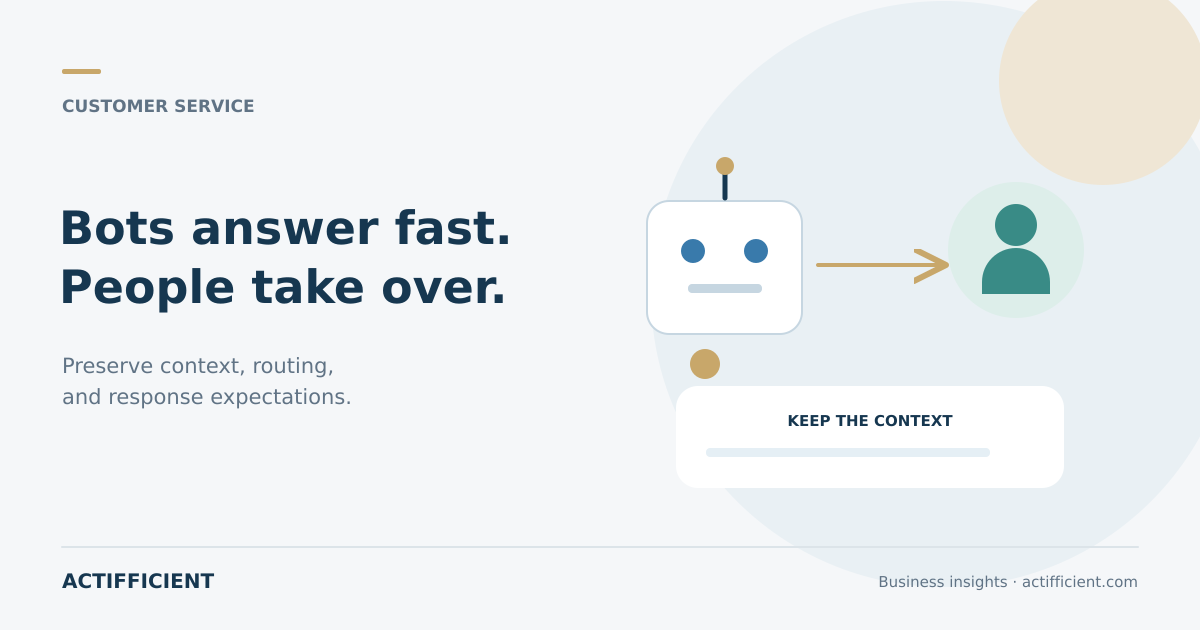
A chatbot can answer questions about opening hours, store locations, basic order status, or appointment steps in seconds. Customers do not always arrive with simple questions, however. Some are frustrated by a failed transaction, unable to explain a complex issue, or waiting for a decision that only an authorized employee can make.
The experience breaks down when a WhatsApp chatbot repeats the same answer and offers no way forward. Speed no longer feels helpful. The customer feels trapped inside an automated conversation.
An implementation using the WhatsApp Business API therefore needs clear transfer rules. The goal is not to send every chat to a person. It is to prevent cases requiring judgment from becoming stuck with automation.
Separate routine questions from decisions
Routine questions have stable answers, such as business hours, required documents, and basic status steps. They are suitable for customer service automation when the information is approved and maintained.
A transfer becomes appropriate when a customer requests an exception, compensation, sensitive data change, or complaint resolution. A bot should also avoid making conclusions about account security, disputed payments, or other sensitive situations.
Document which topics can be answered automatically, which require confirmation, and which must go directly to a person. Review the list whenever policies, products, or operational processes change.
Use several conversation signals
A transfer rule should not depend on one word. Customers describe frustration in many ways. Useful signals include a request for a person, repeated questions, unsuccessful clarification, negative language, or failed verification.
Within the WhatsApp chatbot flow, decide how many clarification attempts are reasonable before offering human assistance. Do not force a customer to repeat menu choices indefinitely.
Provide a visible option such as “Talk to an agent.” A customer who already understands the issue should not have to complete every automated step.
Preserve context during the transfer
An effective chatbot to human handoff transfers more than a message thread. It should provide collected context such as the customer name, reason for contact, transaction number, menu choices, and a concise issue summary.
Without context, customer service agents ask the person to explain everything again. The benefit of automation disappears and resolution takes longer.
Show previous automated replies so the agent understands what the customer has already been told. Clearly label unverified information so it is not mistaken for a confirmed fact.
Route the case to the right queue
Payment, delivery, sales, and technical support cases may require different teams. Customer service escalation should route the conversation to an appropriate queue, not merely the first available employee.
Define priority for urgent cases, customers who have waited a long time, and issues that block a transaction. Create a path for cases the first agent cannot resolve.
With omnichannel customer service, context from another connected channel can help. Access should still follow employee responsibilities and data policies.
Match transfers to service hours
A transfer is not useful when no agent is working. Explain human service hours and a reasonable response expectation. Outside those hours, the bot can collect essential information and create a task for the team.
Avoid promising an immediate response when staffing cannot support it. A clear expectation is more helpful than a fast promise that is missed.
Decide what happens when the customer stops replying after an agent takes over. The conversation can move to a waiting status and close under a consistent rule.
Maintain the knowledge source
The quality of AI customer service depends on the material it uses. Separate approved information from unfinished drafts. Assign content owners and review dates.
Frequent transfers for simple questions can indicate missing or unclear knowledge. Very few transfers may indicate that risk rules are too permissive.
Do not add customer data or internal documents without reviewing access, purpose, and platform requirements.
Measure transfer quality
Do not evaluate a bot only by the percentage of chats completed automatically. Review transfer volume, waiting time after transfer, repeated questions, movement between agents, and reopened cases.
Sample the customer conversation history to identify where confusion begins. Actual conversations help the team improve wording, menus, and routing rules.
Group transfer reasons as well. If one topic dominates, the company may need better information, an operational fix, or specialized training for the team.
A good chatbot does not try to hold every conversation. It resolves routine needs efficiently and recognizes when human judgment is required. That balance supports efficiency without removing the human decision.
Want to organize chatbot responses, shared inboxes, CRM context, and human transfers? Explore Actifficient WhatsApp Business API and omnichannel CRM, then contact Actifficient to discuss question types, agent capacity, service hours, and escalation rules.